Compiled from various sources
Saint Chrysostomos Papasarantopoulos (born Christos) was born in the year 1903 in the village of Vasilitsi, in the district of Koroni, in the region of Messinia. His father was a shepherd from Tripolis and had four children, whom he raised with his second wife after the passing of his first. From this second marriage was born Christos, whom his parents nurtured in the piety of Christ. He attended primary school up to the fourth grade but was compelled to leave and work after his father’s death.
In his quest for spiritual life, the fifteen-year-old Christos came in 1918 to the Monastery of Prophet Elias Panagoulakis in Kalamata. On August 4, 1925, he was tonsured a monk and received the name Chrysostomos. On May 4, 1926, he was ordained deacon by the Metropolitan of Messinia, and the following day he was ordained priest and appointed parish priest of the Church of the “Presentation of Christ into the Temple” in the village of Amphia (Gardiki), Messinia.
From 1934 to 1938, he served as a parish priest in various villages of Messinia and as abbot of a monastery there. The people of Messinia often described him as “without money,” for he possessed no personal wealth — whatever he had, he gave to those in need.
Desiring to complete his formal education, he studied privately in a village and obtained his secondary school certificate.
In 1938, Archbishop Chrysanthos of Athens summoned him to Athens, where he was officially registered among the monks of the Petraki Monastery and ordained Archimandrite. Soon afterward, he was appointed Abbot of the Holy Monastery of Panagia Faneromeni in Salamis.
In 1941, he was appointed Protosyngellos of the Metropolis of Edessa, and in 1950, he served at the Church of Saint Paraskevi of Nea Krini in Kalamaria. Later, he returned again to the Petraki Monastery, where he studied at the Theological School of Athens, obtaining in 1959, at the age of fifty-six, a degree in Theology.
While studying at the Theological School, he met students from Uganda, through whom he learned of the urgent need for evangelization and assistance for the peoples of Africa, who suffered from disease, hunger, and every kind of hardship.
During Pascha (Easter) of 1960, he went on pilgrimage to the Holy Land. In the sacred places where our Lord Jesus Christ lived, was crucified, and rose from the dead, he prayed fervently that the Lord might strengthen him in his new pastoral mission. His mind, soul, and heart were turned toward the destination he had long conceived — to journey to the then-unknown continent of Africa, to become a pioneer and a struggler amid difficult and adverse circumstances, to offer, as a true soldier of Christ, a small token of gratitude to the Lord for His countless blessings throughout his life.
On April 24, 1960, as he recorded in his journal, he arrived at the Port of Alexandria and wrote these words:
“I returned to my room and sat until ten in the evening. Glory be to the Lord, Who has granted me to enter this Black Continent. May His grace aid me to reach my destination and fulfill my mission in the best possible way — for the glory of His Holy Name and His Church, and for the salvation of the many souls for whom He offered Himself upon the Cross.”
The next day, he met His Beatitude Pope and Patriarch Christopher II of Alexandria (1939–1967) and expressed his wish to go voluntarily and temporarily to the interior of Africa for missionary work. The Patriarch, foreseeing the dangers he would encounter, cautioned him about the hardships awaiting him. Yet the zealous missionary did not waver, declaring to the Patriarch his readiness even to sacrifice his life for the sake of the Gospel. He humbly confessed:
“I am unworthy of anything, yet let the work of Christ and His Church be accomplished… O Lord Jesus Christ, for Thy Holy Name I have left my beloved homeland and all that made me happy in Athens, parting from my brethren who believe in Thee there. I have come here — do with me as Thou willest, and as Thou knowest best. Thy holy will be done in all things.”
Though the devil often tried to test his patience and faith, nothing could shake his resolve to bring the light of the Gospel to the nations.
With the blessing of the Pope and Patriarch, and carrying a letter from Metropolitan Nicholas of Irinoupolis (Kenya) — who later became Pope and Patriarch of Alexandria (1968–1986) — the “eagle of the mission,” though elderly, took flight on May 23, 1960, and spread his wings toward the land of his desire.
At last, his feet touched the holy and blessed soil of Africa. He travelled by land from Nairobi to Uganda, which at that time was the missionary center of the Metropolis of Kenya. He was then fifty-nine years old. From that day forward, Africa became his new homeland.
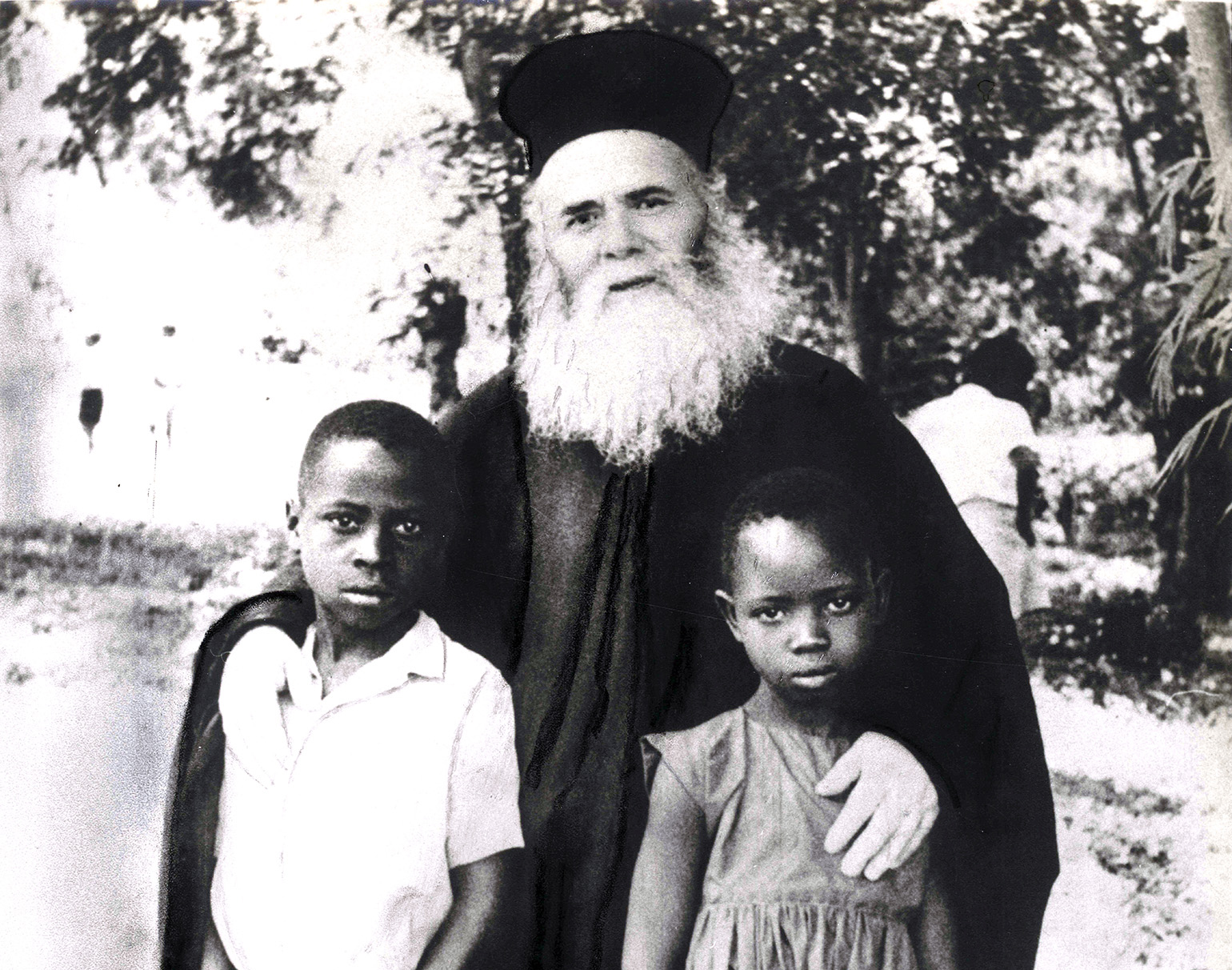
He became the spiritual “Patriarch” of a great family — the Orthodox Mission of Africa. He did not merely live in the mission; he lived for the mission. He is rightly called the founder of the Orthodox Mission in the Congo.
In his old age, leaving behind the comfort of Athens, and relying only on his faith in God, he went alone, physically frail yet spiritually strong, to preach Christ to his African brethren. He had no money — only faith in God and love for mankind. Under severe conditions, he learned both Swahili and Luganda, making the peoples of Uganda, Kenya, Nairobi, and Zaire his own spiritual children. He later expanded his missionary activity to include Tanzania and the Congo.
Through his tireless labors and struggles, Fr. Chrysostomos founded churches and schools, preached the Word of God, and saved many souls within the spiritual jurisdiction of the Patriarchate of Alexandria.
Recognizing his invaluable contribution, Metropolitan Nicholas wrote to him, acknowledging his service:
“In view of your precious labors and your great contribution to the spread of Orthodoxy in the African continent, the Mother Church and our divinely-established Metropolis hereby grant to Your Reverence broad authority and the right to represent us in all ecclesiastical and administrative matters, and to sign, in our absence, all certificates, documents, and other papers about the Holy Metropolis of Irinoupolis (Kenya).”
Saint Chrysostomos Papasarantopoulos fell asleep in the Lord on December 29, 1972, at the age of sixty-nine, and was buried in Kananga. On December 21, 1996, his holy relics were transferred to the garden of the Church of Saint Andrew at the Kananga Mission Center. The African faithful, men and women alike, mourned him deeply and at length, according to their traditions. His tomb has since become a permanent place of pilgrimage for the local Orthodox faithful.
This is the saint who is now honored and blessed as the Illuminator, the “Methodius and Cyril of Africa”, who glorified the Lord by his virtuous life and missionary zeal.
May the Lord of Love glorify him through our Holy Church by numbering him among her saints.
† Metropolitan Nikolaos,
Metropolitan of Hermopolis (Tanta) and its Dependencies,
Patriarchal Commissioner for Arabic Affairs