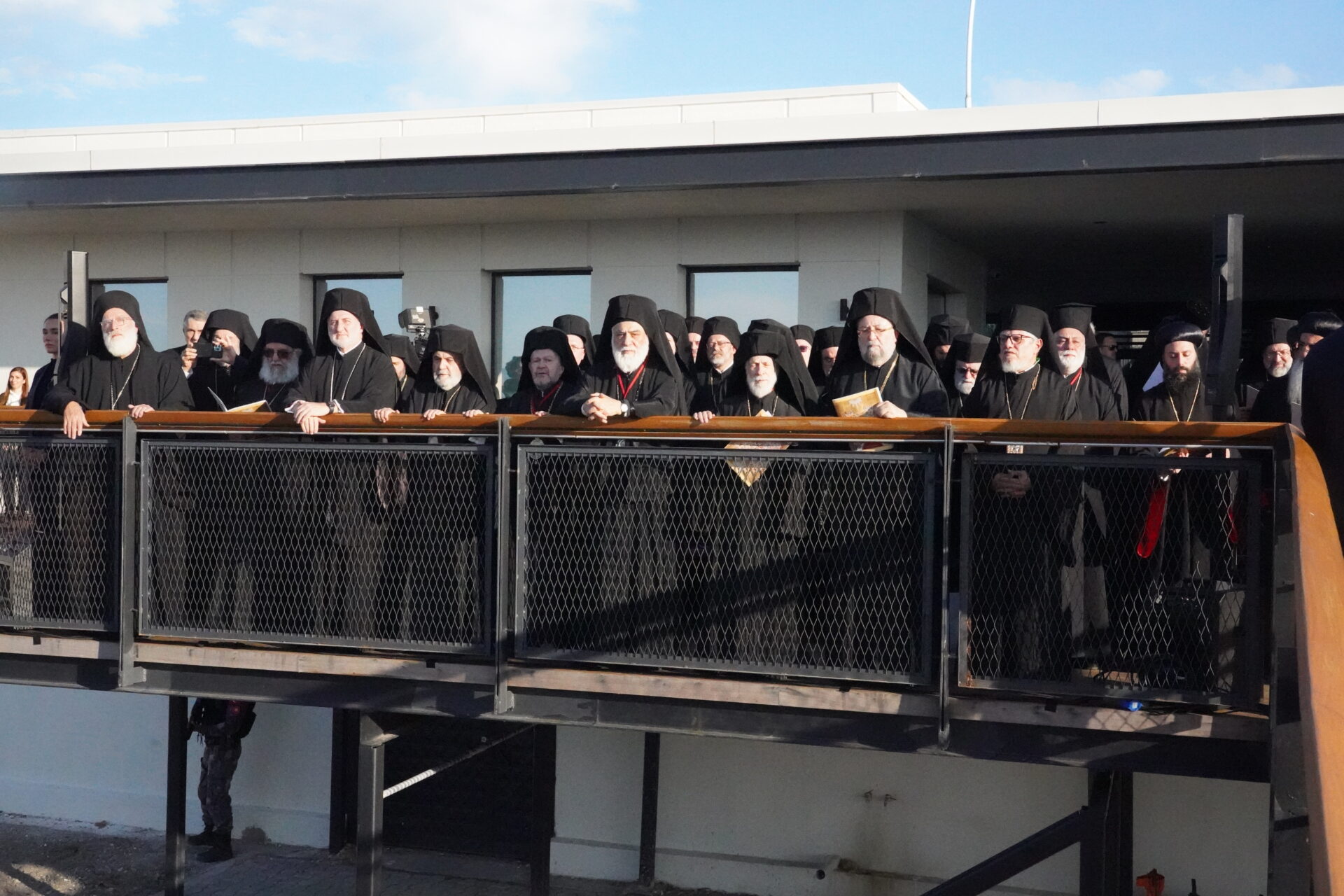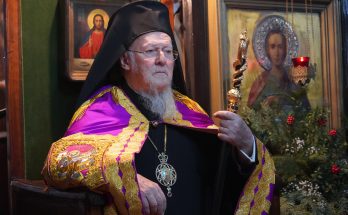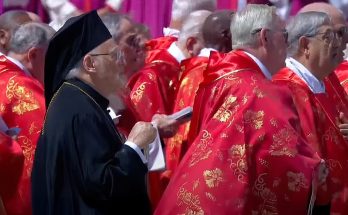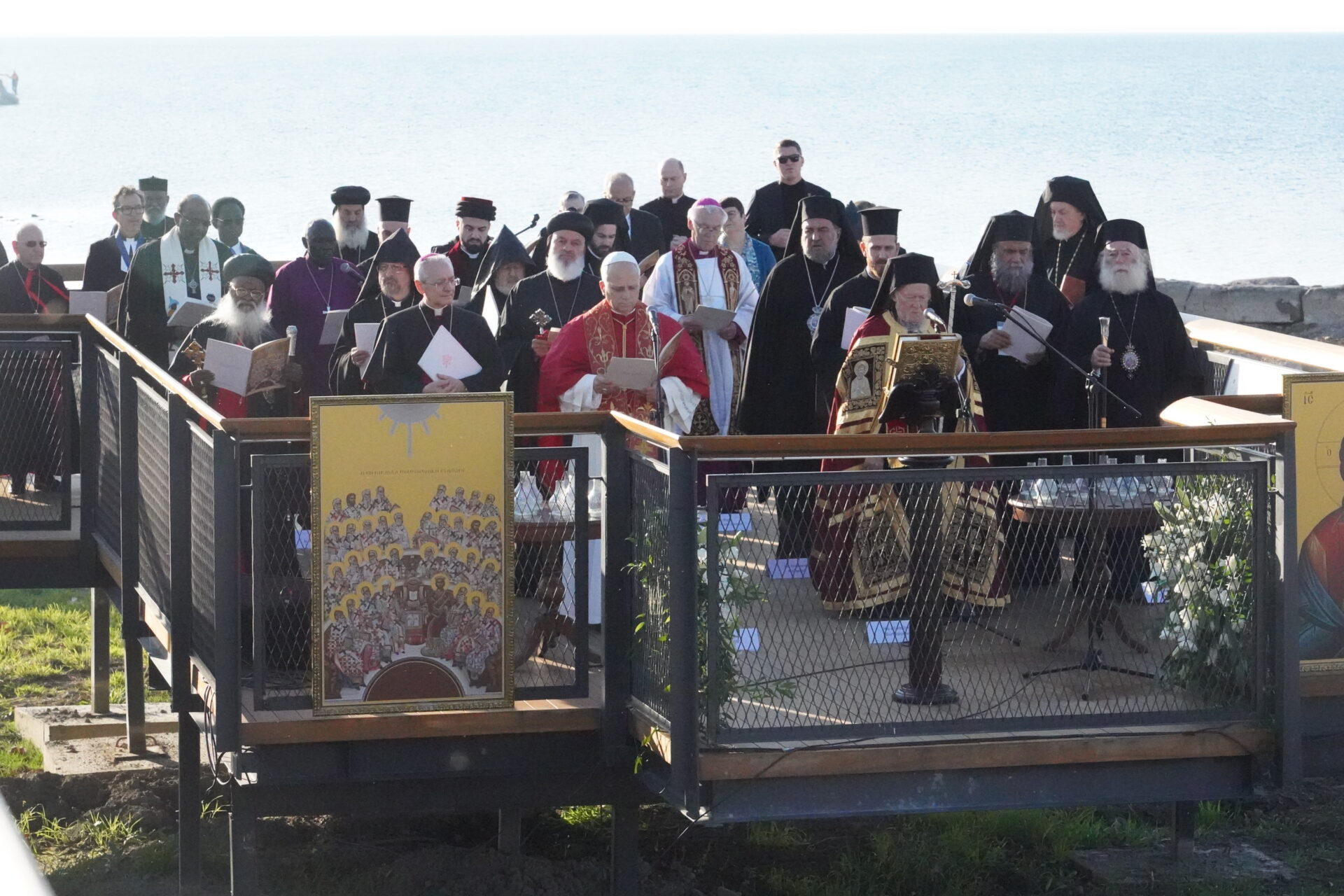
Today, November 28, the Ecumenical Patriarch Bartholomew and Pope Leo XIV of the Roman Catholic Church gathered in Nicaea of Bithynia, in western Turkey, to jointly commemorate the 1700th anniversary of the First Ecumenical Council.
The First Ecumenical Council, convened in 325 CE in the presence of Emperor Constantine the Great, sealed the confession of faith for all of Christianity.
The two Primates of Christianity are accompanied by the heads of other Christian denominations active in Turkey, including the Orthodox Churches of the Syrians, Copts, and Armenians, as well as the Protestant and Anglican Churches, lending the ceremony a distinctly inter-Christian character.
Having all of these religious leaders present in the same place highlights Nicaea’s significance as a site of unity, historical memory, and shared witness to the Christian faith.
His Beatitude, Pope and Patriarch Theodoros II of Alexandria and All Africa also graced this fundamental event of Christianity upon the invitation of His Holiness the Ecumenical Patriarch.
Speech of the Ecumenical Patriarch
Your Holiness, Your Beatitudes, Your Eminences, Venerable Hierarchs and Clergy, Representatives of Christian Churches, Communions and Organizations throughout the world,
Brothers and sisters in Christ:
‘Behold, how good and how pleasant it is for brethren to dwell together in unity!’ (Psalm 132[133]:1)
We are deeply moved that you have all responded positively to our humble invitation to honor through this joint pilgrimage the memory and legacy of the First Ecumenical Council held here, at Nicaea, seventeen-hundred years ago.
Despite so many intervening centuries, and all the upheavals, difficulties, and divisions they have brought, we nevertheless approach this sacred commemoration with shared reverence and a common feeling of hope. For we are gathered here not simply to remember the past. We are here to bear living witness to the same faith expressed by the Fathers of Nicaea.
We return to this wellspring of the Christian faith in order to move forward. We refresh ourselves at these inspired waters of rest (Cf. Psalm 22[23]:2), in order to become strong for the tasks that lie ahead. The power of this place does not reside in what passes away, but in what endures forever. In Nicaea, history bore witness to eternity, to the fact that our Lord and Savior Jesus Christ is true God of true God, consubstantial with the Father (ὁμοούσιος τῷ Πατρί). Enshrined in the Nicene Creed, such expressions distill and present to all the faith of the Apostles.
Beloved brothers and sisters in Christ, the name Nicaea derives from the Greek word for victory (νίκη). When the fallen world thinks of victory, it thinks of force and domination. But as Christians, we are ordered to think differently. Our paradoxical sign of victory is the unconquerable sign of the Cross.
This is ‘foolishness’ to the nations, a sign of defeat, but for us, it is a supreme manifestation of the wisdom and power of God. We do indeed celebrate victory in this place, but it is a victory not of this world, and ‘not as the world gives’ (cf. John 14:27). The Holy Spirit fittingly chose this place to grant the Church a heavenly and spiritual victory. The Apostle John tells us: ‘this is the victory that has overcome the world – our faith’ (1 John 5:4). As Christians, the Apostolic faith which was expressed at Nicaea is our victory. By this faith the tyranny of sin is abolished in our lives, the bondage of corruption is loosed, and earth is raised to heaven.
The Nicene Creed acts like a seed for the whole of our Christian existence. It is a symbol not of a bare minimum; it is a symbol of the whole. Having the fervor of the faith of Nicaea burning in our hearts, ‘let us run the course’ of Christian unity ‘that is set before us’ (cf. Hebrews 12:1); let us ‘hope to the end for the grace’ that is promised ‘at the revelation of Jesus Christ’ (cf. 1 Peter 1:13); and, finally, ‘let us love one another, that with one mind we may confess: Father, Son, and Holy Spirit, Trinity consubstantial and undivided’.[1] Amen!
Address by Pope Leo XIV
In his address, the Pope thanked Ecumenical Patriarch Bartholomew, for his “great wisdom and foresight” in calling for Church leaders to celebrate this important anniversary together, according to Vatican News.
He also expressed appreciation to the Heads of Churches and Representatives of Christian World Communions for attending the event.
Pope Leo recalled that the Council of Nicaea was held in 325, saying it invites all Christians, even today, to ask ourselves who Jesus Christ is for us personally.
“This question is especially important for Christians,” he said, “who risk reducing Jesus Christ to a kind of charismatic leader or superman, a misrepresentation that ultimately leads to sadness and confusion.”
The Council was held to respond to the Alexandrian priest Arius’ claim that Jesus was only an intermediary between God and humanity, saying He was not fully divine and ignoring the reality of the Incarnation.
“But if God did not become man, how can mortal creatures participate in His immortal life?” asked Pope Leo. “What was at stake at Nicaea, and is at stake today, is our faith in the God who, in Jesus Christ, became like us to make us ‘partakers of the divine nature’.”
The Council of Nicaea, he said, agreed upon the Christological confession we now call the Nicene Creed, which is professed by all Christian Churches and Communities.
The Symbol of Faith, as it is known, was of “fundamental importance in the journey that Christians are making towards full communion.”
“Faith ‘in one Lord Jesus Christ, the Only Begotten Son of God, born of the Father before all ages… consubstantial with the Father’ (Nicene Creed),” he said, “is a profound bond already uniting all Christians.”
The Pope invited Christians to embrace that existing bond of unity and journey ever deeper in “adherence to the Word of God revealed in Jesus Christ, under the guidance of the Holy Spirit, in mutual love and dialogue.”
By overcoming divisions and reconciling with one another, Christians can bear more credible witness to Jesus Christ and His proclamation of hope for all, he said.
Pope Leo XIV went on to say Christian unity is greatly needed in our world filled with violence and conflict.
“The desire for full communion among all believers in Jesus Christ is always accompanied by the search for fraternity among all human beings,” he said, calling for recognition of the rights and dignity of all people, no matter their ethnicity, nationality, religion, or personal perspectives.
He upheld the role of religions in serving truth and encouraging individuals to seek dialogue and respect.
“We must strongly reject the use of religion for justifying war, violence, or any form of fundamentalism or fanaticism,” the Pope said. “Instead, the paths to follow are those of fraternal encounter, dialogue and cooperation.”
In conclusion, Pope Leo prayed that God the Father may help the commemoration of the 1,700th anniversary of the Council of Nicaea bear “the abundant fruits of reconciliation, unity and peace.”
Photo Credit: Nikos Papachristou