At the heart of Orthodox Church worship lies the celebration of the Divine Liturgy, where every sacred object carries deep spiritual meaning. Among these is the Antimension, a consecrated cloth that symbolizes the Church’s unity, apostolic tradition, and communion with the bishop, serving as the sacred foundation upon which the Holy Eucharist is celebrated.
Many faithful have attended the Divine Liturgy for decades. They watch the priest unfold a distinctive cloth upon the Holy Table, place the Holy Gifts upon it, and, at the conclusion of the service, fold it again with great care. Yet how many truly know what it is? This sacred cloth is called the Antimension, and it is one of the most important liturgical furnishings of the Orthodox Church.
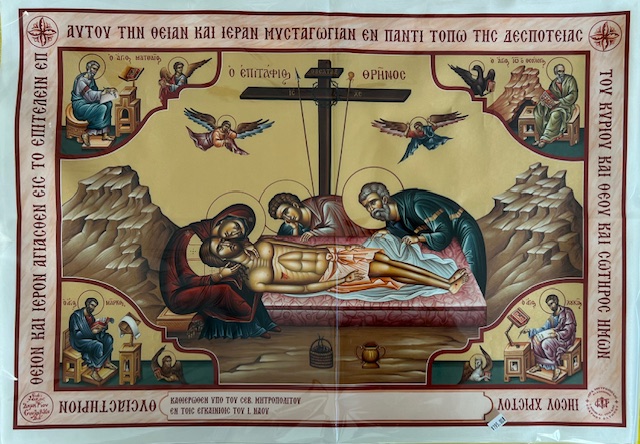
The term derives from the Greek prefix anti (“instead of”) and the Latin mensa (“table”), literally meaning “in place of the table.” The Antimension is a consecrated cloth, usually made of silk or linen, bearing the image of the Burial of Christ, together with figures and symbols associated with His Passion. Sewn into it are holy relics of martyrs, a tradition dating back to the earliest centuries of Christianity, reflecting the profound connection between the Holy Eucharist and the witness and sacrifice of the martyrs.
The Antimension, a symbol of ecclesiastical authority
One feature of the Antimension often goes unnoticed: the signature of the Canonical Bishop. This signature is far more than an administrative formality. The Antimension is consecrated and issued by the bishop, serving as the visible sign of canonical communion with him and of the ecclesiastical authorization to celebrate the Divine Eucharist. A presbyter does not celebrate the Divine Liturgy independently; he celebrates it within the life of the Church, in communion and unity with his bishop.
For this reason, the priest handles the Antimension with profound reverence and kisses it during the Divine Liturgy. This kiss is not a merely ceremonial gesture. It expresses veneration for the sacred Antimension while simultaneously affirming the celebrant’s communion with both the bishop and the Church. At that moment, the priest is deeply conscious that he is not celebrating the Divine Liturgy on his own authority or in his own name, but within the apostolic and canonical order of the Church.
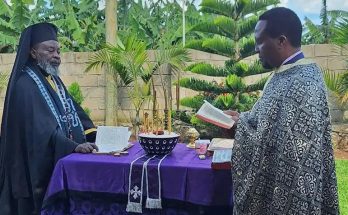
The Antimension is unfolded upon the Holy Table at a specific point during the Divine Liturgy, and it is upon this sacred cloth that the Mystery of the Holy Eucharist is celebrated. The Holy Gifts are placed upon it, and there the consecrated Lamb remains. For this reason, the special liturgical sponge is used with exceptional care afterward, ensuring that not even the smallest particle of the Holy Gifts remains. The Antimension is then carefully folded and preserved with the reverence due to so sacred an object.
Perhaps this is the most profound lesson of the Antimension. Upon a single piece of consecrated cloth are symbolically united Christ and His Tomb, the martyrs, the bishop, the priest, and the people of God. It is a miniature image of the Church herself: no one stands alone; all are united around Christ.
The next time you attend the Divine Liturgy and see the priest carefully unfolding that sacred cloth upon the Holy Table, you will know that it is not merely a liturgical covering.
It is the Antimension. And upon it, the Church’s greatest Mystery—the Holy Eucharist—will soon be celebrated.
Perhaps, after all, the Divine Liturgy contains many realities that we see every Sunday, yet whose true meaning we have only begun to discover.
Source: Holy Archdiocese of Accra Ghana